
Written by: Bill Carton
Edited by: Lucy Ahern & Megan Thomas
Company: Anomer Bio
Location: Victoria House, London
Founded: 2024
Founders: Sophie James and Marcos Burger Ramos
Every cell in the human body is coated in a dense forest of sugar molecules known as glycans. This sugar coating, known as the glycocalyx, plays a central role in how cells communicate with one another, how the immune system distinguishes friend from foe and how tissues develop and maintain their integrity [1]. The enzymatic process through which these glycan structures are built, known as glycosylation, occurs mainly within the cell [2]. This process gives rise to a diversity of cell surface proteins with these sugar molecules attached and these play vital roles in cell-cell adhesion, interaction, and communication. In healthy cells, glycosylation is a tightly regulated and essential process. However, in diseased cells, this regulation often breaks down in ways that are clinically significant. Altered glycosylation has been implicated across a remarkably diverse range of conditions including cancer, neurodegeneration, inflammatory and autoimmune diseases, lysosomal storage disorders and cardiovascular disease [3].
The mechanisms by which aberrant glycosylation contributes to disease are varied. In cancer, for example, tumour cells frequently exhibit abnormal glycosylation patterns that can disguise them as healthy cells, enabling them to evade detection by the immune system [4, 5]. In neurodegeneration, abnormal glycosylation of proteins such as tau and amyloid precursor protein is thought to influence their aggregation and clearance, with direct implications for conditions like Alzheimer’s disease [6]. Meanwhile, in lysosomal storage disorders, inherited deficiencies in glycan-degrading enzymes cause undegraded glycans to accumulate progressively within cells, ultimately leading to irreversible tissue and organ damage [7].
Despite their importance in both health and disease, glycans have historically been overlooked in research. This is largely because, unlike proteins, they are not directly encoded for by genes and cannot easily be labelled or tracked using conventional molecular tools. As a result, our understanding of glycosylation has lagged behind other areas of biology and therapeutic strategies targeting glycans remain scarce.
However, this began to change through the pioneering work of Professor Carolyn Bertozzi at Stanford University. Prof. Bertozzi developed so-called biorthogonal reactions: chemical reactions that can take place inside living cells without disrupting normal cellular functions. Her approach involved engineering synthetic monosaccharides, a type of modified sugar molecule, that were taken up by the cell and naturally incorporated into the glycocalyx [8, 9, 10]. Once embedded in the surface of the cell, these synthetic sugars could be targeted by chemical probes, enabling researchers to visualise and study glycans with unprecedented precision. It was this work that earned Prof. Bertozzi a share of the 2022 Nobel Prize in Chemistry.
Beyond the Nobel Prize, Prof. Bertozzi’s work showed that glycosylation had become a tractable therapeutic target and molecules which had previously been difficult to study could now be interrogated in the context of disease. This marriage of synthetic chemistry, cell metabolism and glycobiology, along with the advancement of computational AI-enabled tools, is what inspired Dr. Marcos Burger Ramos and Dr. Sophie James to set up Anomer Bio.
Anomer Bio is using their proprietary computational models to design and screen glycan-targeting small molecules. They are developing synthetic monosaccharides as single-agent therapeutics with the aim of reprogramming aberrant glycosylation across a range of disease contexts. Their initial focus is on Sanfilippo syndrome, a rare and devastating childhood neurodegenerative disease caused by the inherited deficiency of an enzyme responsible for breaking down a specific type of glycan. Without this enzyme, the glycan accumulates progressively within cells, driving dysfunction and irreversible damage. There are currently no approved disease-modifying treatments for Sanfilippo syndrome. Anomer Bio aims to change that. By harnessing their synthetic monosaccharide platform to develop new treatments which intervene directly at the glycan level, they hope to halt this pathological accumulation and, in doing so, slow or stop disease progression in a condition that has long been without a therapeutic answer.
Anomer Bio was co-founded by two ambitious scientists with complementary expertise: Dr. Marcos Burger Ramos, a chemist by training, and Dr. Sophie James, a biologist.
Sophie (CEO) completed her PhD across the Bart’s Cancer Institute, the Francis Crick Institute and Imperial College London researching mechanisms of drug resistance in Acute Myeloid Leukemia (AML). Her entrepreneurial ambitions were confirmed during her PhD whilst taking part in an innovation challenge at the Crick, in which Sophie’s team won the pitching competition. After this experience, she set out on a path to start a biotech company of her own and the opportunity came when she reconnected with Marcos at a networking event. As is the case with many good ideas, a subsequent trip to the pub planted the seeds of what would become Anomer Bio.
Marcos (CSO) also carried out his PhD at the Bart’s Cancer institute, where he and Sophie first met. Marcos’ PhD project involved researching the tumour microenvironment in collaboration with another start-up called Neobe Therapeutics, which was recently covered in a Startup Spotlight by the SEC that can be found here. Marcos was inspired by the startups he was working with as part of Matrix Dynamics, the pre-clinical testing platform he co-founded during his PhD. Realising that glycans are critical drivers of disease, he began thinking about ways he could approach these biological problems with a chemistry driven approach.
Together, Sophie and Marcos combined their respective biology and chemistry expertise to develop the science behind Anomer Bio. They realised that they could use synthetic monosaccharides to modify cellular glycosylation, with the potential to overcome immune barriers to disease and alter key interactions within the extracellular matrix. Drawing on publicly available datasets, they built their proprietary computational models to guide the design and screening of their initial chemical structures. This early work secured funding from SOSV, a global venture capital firm, through their IndieBio accelerator programme. As part of this funding, Sophie and Marcos spent three months at SOSV’s New York offices learning and networking with other founders and investors in the biotech space. They returned to the UK at the end of 2025 and in the last 3 months they have shown that hits from their in-silico screen inhibit their first glycan target more effectively than the clinical benchmark – a striking early proof-of-concept for their platform.
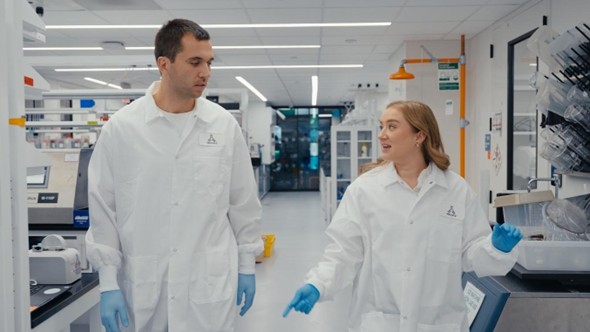
Sophie and Marcos’ vision for the future of Anomer Bio is ambitious. While their initial focus is on Sanfilippo syndrome, the broad prevalence of aberrant glycosylation across many disease areas creates a huge opportunity. Work on collaborative grants to continue to build out work in oncology and fibrosis is already underway. For now, they are focused on taking their in vitro hits into in-vivo studies for the first program and building out their platform. When asked about longer-term goals, Sophie expressed her hope to see Anomer Bio in the clinic with a synthetic sugar therapeutic as soon as 2028 and for the next decade to bring a new wave of approved drugs targeting glycans.
Despite promising research, very few FDA approved drugs target glycans. Most FDA approved drugs target proteins. However, the glycans that coat cell surface proteins are not passive bystanders, they are active mediators of cell behaviour, disease progression and immune evasion. As Sophie put it, if we continue to overlook this crucial layer of biological interaction, our ability to develop truly effective new therapies will remain fundamentally limited.
Anomer Bio have built impressive momentum in their earliest days and the coming months and years promise to be equally as exciting for Anomer. To follow their story or find out more, visit www.anomer.bio or find them on LinkedIn.

Sign up for our monthly newsletter of upcoming events, recently published insights, member news and SEC updates.
.jpg)
